
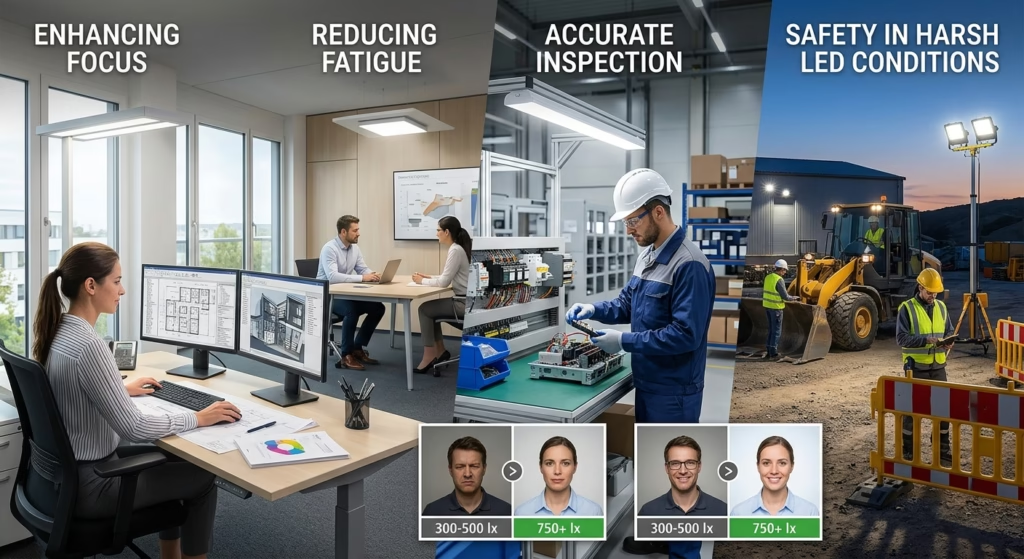
Lighting often becomes a background decision: businesses use whatever fixtures came with the building and leave them in place until a bulb fails. However, a large body of ergonomics and occupational health research considers illumination a direct factor in task performance, alongside noise, temperature, and workstation layout.
When light levels fall below what a task requires, the eyes compensate by dilating the pupils and increasing the muscular effort needed to focus. Over an entire shift, this extra effort can increase visual fatigue. Fatigued eyes take longer to detect small differences, such as a misread dimension, a missed defect, or a transposed digit. These small errors can eventually lead to rework, quality problems, or, in industrial environments, safety incidents.
The reverse also applies: more light does not automatically produce better results. Excessive lighting increases glare and energy consumption. Beyond a certain point, additional light provides little improvement in task accuracy while creating greater visual discomfort.
The useful question is not “brighter or dimmer?” but “does the lighting match the task?” That principle forms the foundation of modern lighting standards.
What the Standards Actually Recommend
Several reference frameworks help organizations define adequate illumination according to task type, both internationally and in Indonesia. Although these standards do not always specify identical values, they follow the same basic principle: the more visually demanding a task becomes—or the greater the cost of an error—the higher the required lux level.
EN 12464-1 (Europe) — This widely cited indoor workplace lighting standard specifies around 500 lx for standard office workstations, lower levels for corridors and storage areas, and higher levels for fine or detailed work. It also addresses glare control (UGR), uniformity, and colour rendering.
IES RP-3 / IES Lighting Handbook (United States) — IES guidance provides similar task-based lighting levels for North American workplaces, along with recommendations for colour temperature and visual comfort.
Permenaker No. 5/2018 and SNI 7062:2019 (Indonesia) — Indonesia’s occupational safety regulation and national measurement standard establish minimum lux levels according to activity type and explain how workers should measure illumination with a calibrated lux meter. These standards also echo the older Kepmenkes No. 1405/2002 minimum of roughly 300 lx for general workspaces.
A simplified comparison across common work areas looks like this:
| Work Area / Task | Typical Lux | Reference Basis |
|---|---|---|
| Outdoor yards, general circulation paths | 20–50 lx | Common minimums for outdoor work areas |
| Warehousing, bulk material handling | 100–200 lx | EN 12464-1; Permenaker No. 5/2018 |
| Corridors, stairs, storage rooms | 100–150 lx | CIBSE SLL Code; EN 12464-1 |
| General office work, meeting rooms | 300–500 lx | EN 12464-1:2021; IES RP-3-20 |
| Data entry, detailed paperwork, drafting | 500 lx | EN 12464-1; Kepmenkes No. 1405/2002 (≥300 lx floor) |
| Fine assembly, quality inspection | 750–1,000+ lx (task lighting) | EN 12464-1; IES RP-7 |
| Indonesian workplaces (general reference) | 300–1,000 lx by task | Permenaker No. 5/2018; SNI 7062:2019 |
Two points deserve attention.
First, these values generally refer to measurements taken at the task plane, such as desk height or the actual work surface. They do not simply represent the overall “brightness” of a room.
Second, most standards provide a range rather than one fixed number because lighting uniformity matters as much as the average reading. For example, a room that averages 500 lx but has dark corners measuring only 150 lx can perform worse than a room that maintains an even 400 lx throughout the work area.
Beyond Lux: Glare, Flicker, and Colour Rendering
Illuminance receives most of the attention, but three additional factors determine how effectively workers can use that light.
- Glare (UGR) — Bright fixtures positioned directly within a worker’s line of sight can create discomfort glare. Workers may start blinking or squinting before they consciously recognize the lighting as too bright. Recessed or shielded fixtures with a low Unified Glare Rating generally work better than exposed, high-output lamps at workstations facing screens.
- Flicker — Older fluorescent tubes and poorly designed LED drivers can produce flicker at frequencies that people cannot consciously see but that the visual system can still detect. Over long shifts, this flicker may contribute to headaches and eye strain. Driver quality plays an important role in flicker performance, not just the quality of the LED chip.
- Colour Rendering Index (CRI) — A CRI above 80 provides a common baseline for general work areas. Colour-critical inspection tasks may require CRI 90+ because workers need to distinguish colours accurately. Examples include electrical wiring checks, paint matching, and food quality control, where an incorrect colour judgment can have real consequences.
A fixture can meet the required lux level while still performing poorly in one or more of these areas. For this reason, a lighting audit that measures brightness alone provides an incomplete picture of lighting quality.
Daylight, Colour Temperature, and Alertness
Illuminance represents only one part of effective lighting. Colour temperature, measured in kelvin, also influences alertness through its interaction with the body’s circadian rhythm.
Cooler, blue-toned light, typically around 5000–6500K, tends to support alertness and often suits production areas and control rooms. Warmer light, around 3000K, creates a more relaxed and less stimulating atmosphere, making it more suitable for rest and break areas than active workstations.
Where possible, businesses should treat daylight as an important part of good lighting design rather than as something to eliminate. Daylight provides a broad colour spectrum and naturally supports the body’s circadian rhythm. This helps explain why newer revisions of EN 12464-1 place greater emphasis on room brightness and wall and ceiling illuminance instead of focusing only on the desk or work surface.
However, many workplaces receive limited daylight. Basement work areas, night-shift operations, and enclosed production halls may receive little or no natural light. In these environments, artificial lighting must compensate more deliberately for both quantity and colour balance.
Industrial and Outdoor Sites: A Different Calculation
Office lighting guidance dominates much of the available literature, but many workers operate in warehouses, workshops, construction sites, and outdoor or off-grid locations. These environments change the lighting calculation in three important ways.
- Task variability is higher. A single warehouse floor may require 150 lx for general circulation but more than 500 lx at a nearby picking or inspection station. This situation often favors zoned or supplementary task lighting instead of one uniform ceiling grid.
- Environmental exposure matters. Outdoor and semi-outdoor fixtures face dust, moisture, vibration, and temperature changes that indoor-rated fixtures may not withstand. The appropriate ingress protection (IP) rating and stable mounting directly affect safety and how quickly lighting performance can degrade.
- Power availability is not guaranteed. Remote sites, night construction projects, and locations without stable grid connections may depend on independent or backup power sources to maintain consistent lighting. Power availability therefore becomes a maintenance and planning issue as well as an electrical consideration.
In these environments, a light level may appear adequate on paper but still fail in practice if the system cannot maintain that output throughout every shift. Uneven lighting can also create darker areas around the edges of a work zone, where workers may face greater safety risks.
Common Mistakes That Undercut a Lighting Upgrade
- Replacing fixtures without measuring first — Swapping one lamp for another assumes that the original lighting design worked correctly. Older buildings often have lighting layouts that no longer meet current requirements.
- Chasing lumens instead of lux at the task plane — A high-output fixture can still produce disappointing lux levels at the work surface if installers mount it too high or too far away.
- Ignoring the maintenance factor — Dust accumulation and lamp degradation gradually reduce light output. Standards account for this decline through a maintenance factor because day-one performance rarely matches performance in the third year.
- Using uniform ceiling grids for non-uniform tasks — General lighting rarely provides the ideal conditions for both circulation and precision work. Supplementary task lighting can solve this problem without over-lighting the entire room.
- Treating lighting as purely aesthetic — Businesses often choose colour temperature and CRI based only on appearance. They should also consider whether those characteristics suit the visual demands of the tasks workers perform.
A Practical Starting Point for a Lighting Review
Improving workplace lighting does not necessarily require a complete retrofit. A structured review can reveal whether the main problem comes from insufficient illuminance, glare, poor colour quality, flicker, or inadequate maintenance.
Start with these steps:
- Measure actual lux levels at representative task points with a calibrated lux meter. Follow a recognized method such as SNI 7062:2019 rather than relying on visual impressions.
- Compare the measurements with the applicable standard for each area, such as an office, warehouse, corridor, or inspection station. A single target rarely works for a facility with multiple types of work.
- Check uniformity, not just the average. Measure across each work zone, including corners and areas near columns or shelving that may block or reduce light.
- Inspect for glare and flicker, particularly around computer screens and inspection stations where workers depend on visual precision.
- Confirm the stability of the power supply. The system should maintain its designed output throughout a full shift, especially at sites without a reliable grid connection.
These steps reduce guesswork. International references such as EN 12464-1 and IES RP-3, together with Indonesia’s Permenaker No. 5/2018 and SNI 7062:2019, provide established guidance for setting lighting targets across different work areas. The next step involves measuring actual conditions and addressing the gaps.
Closing Thought
Lighting rarely receives recognition when everything works correctly. That makes it easy for businesses to under-invest in workplace illumination.
A workforce that struggles with 150 lx when a task requires 500 lx may not describe the problem as a lighting issue. Managers may instead attribute slower work to staffing, training, or process problems.
A proper lighting review changes that assumption. By measuring actual illumination against recognized standards, businesses can identify whether lighting contributes to productivity, quality, or safety problems—and take targeted action to close the gap.
Good workplace lighting is not simply about making a space brighter. It is about providing the right amount and quality of light for the people, tasks, and environment.
Leave a Reply