
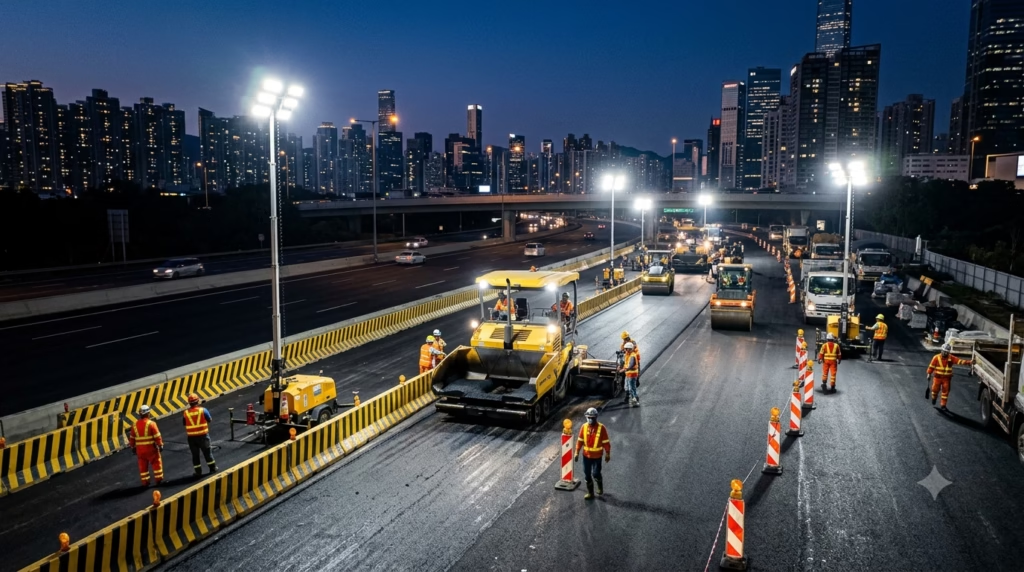
Night construction work has become increasingly common, especially on toll roads, rail corridors, and projects in densely populated urban areas where contractors need to avoid daytime traffic disruption. However, working after dark creates a different set of safety challenges than daytime operations. Reduced natural light, worker fatigue, and limited visibility create risks that every contractor and project manager must take seriously.
This article examines the key risks of night construction work, relevant safety standards, and practical measures that contractors can implement to maintain productivity without compromising crew safety.
Why So Many Construction Projects Run at Night
Contractors schedule work at night for several reasons. They may want to avoid traffic congestion on road and bridge projects, meet tight project deadlines, comply with local regulations that restrict daytime construction in populated areas, or protect workers from extreme daytime heat on outdoor sites.
Although night work offers clear operational advantages, it also requires stronger risk management than daytime operations.
Key Risks of Working on Construction Sites at Night
1. Reduced Visibility
Without natural light, workers may struggle to identify hazards such as excavation pits, scattered materials, structural edges, and moving heavy equipment. Inadequate artificial lighting increases the risk of trips, falls, and workers getting struck by equipment.
2. Fatigue and Disrupted Circadian Rhythm
Night work requires employees to work during the hours their bodies normally reserve for rest. This schedule can disrupt the circadian rhythm, reduce concentration, and slow workers’ reactions to nearby hazards.
3. Limited Visual Communication
Poor lighting can make warning signs, road markings, and hand signals much harder to see. As a result, workers may have greater difficulty coordinating with other crew members and equipment operators.
4. Interaction with Public Traffic
Construction projects near public roads face an additional challenge. Drivers traveling at night may have less time to recognize a work zone and react to hazards, particularly when contractors do not provide clear lighting, signage, and visual warnings.
Relevant Standards and Regulations
Several international references address safety during night work. These include workplace lighting requirements within national occupational health and safety regulations, the IES (Illuminating Engineering Society) RP-8 guideline for roadway and outdoor work-area lighting, OSHA 1926.56 for minimum illumination at construction sites, and the ANSI/ISEA 107 standard for high-visibility apparel and equivalent reflective personal protective equipment (PPE).
Following these standards goes beyond administrative compliance. Proper lighting, visibility, and high-visibility equipment can directly support safer conditions and help reduce workplace accident risks.
Night Construction Safety Tips
1. Ensure Even, Adequate Lighting Across the Work Area
Adequate and evenly distributed lighting represents one of the most important factors in night work safety.
Contractors should eliminate dark spots that could hide hazards and plan light placement around the main work zone, access routes, and equipment movement paths. Concentrating several lights in one location can leave other areas poorly illuminated.
Portable tower lights offer a practical solution because crews can reposition them as the work progresses. They also provide much wider coverage than standard portable work lamps.
2. Use PPE with Reflective Elements
High-visibility vests, helmets, and workwear with reflective strips help equipment operators and passing drivers identify workers more easily.
Reflective PPE provides an additional layer of visibility, particularly in areas where the main lighting system cannot illuminate workers from every angle.
3. Manage Shift Schedules and Rest Breaks Wisely
Contractors should use reasonable shift rotations, provide adequate rest breaks, and monitor workers for signs of fatigue throughout the night.
A safety briefing at the beginning of each shift can also help the crew understand the specific hazards they may encounter that night.
4. Install Reflective Signs and Barricades
Warning signs, cones, and barricades should include reflective elements or flashing lights. These features help workers and approaching drivers recognize the work zone from a greater distance.
5. Equip Heavy Machinery with Visual and Audio Warning Systems
Construction equipment should use rotating beacons, backup alarms, and rear-view cameras whenever appropriate.
These systems help operators and nearby workers recognize machine movements despite the reduced visibility that comes with nighttime operations.
6. Strengthen Team Communication
Workers should not rely entirely on hand signals during night operations.
Two-way radios provide a reliable way to communicate instructions and warnings when workers cannot maintain direct visual contact. Clear radio communication becomes particularly important around heavy machinery and large work zones.
7. Prepare a Night-Specific Emergency Response Plan
Emergency vehicle access routes, assembly points, and emergency contact information should remain easy to locate and clearly visible in low-light conditions.
Contractors should also conduct emergency drills under nighttime conditions rather than relying exclusively on daytime exercises. Night drills can reveal visibility and access problems that daytime exercises may overlook.
8. Ensure a Stable Power Supply
Night projects depend heavily on reliable power for lighting, communication systems, and other essential equipment.
A sudden power failure can immediately create a dangerous total-darkness situation. Contractors should therefore maintain backup power systems and perform routine maintenance on lighting equipment as part of their core safety planning.
Night Work in Practice: Regional Considerations
Night construction plays an important role in toll road and urban infrastructure projects. Contractors often schedule paving, line marking, and bridge repairs overnight to minimize disruption to daytime traffic.
Projects in densely populated areas may also face local restrictions that limit daytime construction hours. These restrictions can push structural, electrical, and other construction activities into the evening and nighttime.
Climate conditions add another consideration. Construction sites may range from humid coastal environments to cooler highland locations with significantly lower nighttime temperatures. Contractors should select lighting equipment that can withstand the environmental conditions at each project site.
Frequently Asked Questions
What is the minimum lighting level required for a night construction site?
Required lighting levels depend on the task and work environment. General work areas typically require illumination well above standard street-lighting levels, while detailed activities such as welding and electrical installation require additional, focused task lighting at the point of work.
Are LED tower lights better than halogen or metal halide units?
LED tower lights generally consume less fuel or electricity, provide longer operating life, and produce less heat than halogen or metal halide alternatives. These characteristics make LED systems an efficient option for projects that operate through long, continuous night shifts.
Is night shift construction work actually riskier than daytime work?
Safety data generally shows higher accident rates during night shifts. Reduced visibility and worker fatigue contribute to this increased risk. Contractors therefore need additional safety measures to bring night-shift conditions closer to the safety levels of daytime operations.
Choosing the Right Tower Light for Night Construction Projects
Because lighting forms the foundation of night work safety, selecting the right tower light directly affects the effectiveness of many other safety measures.
When evaluating a tower light, consider the following factors:
- Brightness output (lumens) — Choose sufficient output to illuminate the required work-area radius.
- Light source — LED units generally offer better energy efficiency and longer operating life than conventional halogen lamps.
- Weather resistance — Select equipment that can withstand site conditions such as rain, dust, and changing temperatures.
- Mobility — A portable unit allows crews to move the light as the work zone changes.
- Runtime — Consider how long the tower light can operate before it requires refueling or recharging.
Tower lights that combine LED lighting with adjustable telescopic masts offer flexibility across many project types, including toll road construction, mining operations, and multi-story building projects.
Weather-resistant and easily movable units also allow field crews to adjust lighting quickly as the work zone changes throughout the project.
Conclusion
Night construction safety requires more than simply adding lights to a worksite. Contractors need to combine adequate lighting, reflective PPE, effective communication, fatigue management, visible warning systems, reliable equipment, and a night-specific emergency plan.
Among these measures, proper and evenly distributed lighting plays a particularly important role. A well-designed lighting system helps workers identify hazards, allows equipment operators to see surrounding personnel, and improves visibility across access routes and active work zones.
Investing in a quality tower light therefore goes beyond visual comfort. It represents an important risk-management measure that can support both worker safety and project efficiency during nighttime operations.
Need a lighting solution for your night construction project? Portaled offers energy-efficient LED tower lights designed for construction, industrial, and outdoor applications. The equipment provides dependable illumination while supporting the demanding conditions found on project sites across Indonesia.
Visit Portaled – Reliable Tower Lighting for Construction & Industry to explore the available tower lighting solutions and discuss your project’s lighting requirements with the technical team.
Leave a Reply