
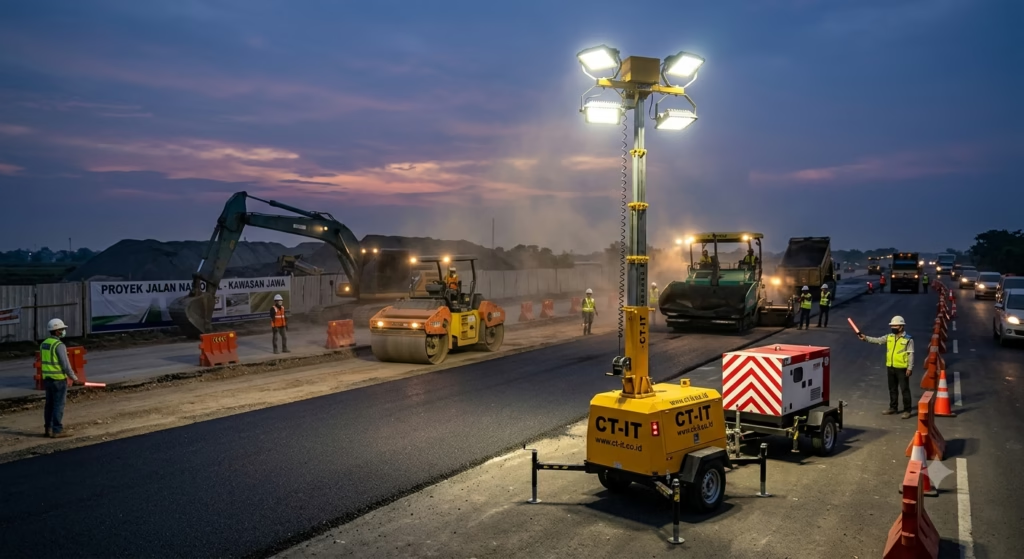
Road construction projects whether a new toll road, a highway widening, or municipal repaving work depend on a wide range of equipment working together on a tight schedule. Missing or underperforming equipment in any single category can delay a project, increase costs, or create safety hazards on site. This guide walks through the essential equipment categories every road project needs, from heavy machinery to the site power and lighting systems that keep everything running.
Understanding what each category contributes and where the common gaps usually show up helps contractors plan procurement and rental more accurately before mobilization, rather than discovering shortfalls once the crew is already on site.
1. Earthmoving and Grading Equipment
Excavators, bulldozers, and motor graders form the backbone of any road project’s early phase, handling site clearing, cut-and-fill work, and subgrade preparation. Grading accuracy at this stage determines how well the rest of the pavement structure performs over the road’s lifespan, so equipment condition and operator skill both matter as much as raw horsepower.
2. Compaction Equipment
Vibratory rollers and plate compactors are used to compact subgrade, base, and asphalt layers to the density specified in the project’s engineering documents. Under-compacted layers are one of the leading causes of premature road failure, including rutting and cracking, which makes reliable compaction equipment a non-negotiable part of the fleet.
3. Paving and Asphalt Equipment
Asphalt pavers, asphalt distributors, and concrete paving equipment lay down the final riding surface. Consistent paver speed and asphalt temperature control are critical for surface smoothness and long-term durability, particularly on projects with tight lane-closure windows that limit available paving time.
4. Surveying and Positioning Equipment
Total stations, GPS-based machine control systems, and laser levels ensure alignment, grade, and elevation stay within the tolerances set by the project design. GPS-guided grading and paving in particular has become standard on larger road projects, reducing rework caused by manual survey error.
5. Traffic Control and Signage Equipment
Cones, barriers, message boards, and temporary signage protect both the workforce and the traveling public while work is underway, especially on projects that keep partial traffic flow open during construction. Clear, well-maintained traffic control equipment is often a direct requirement of the project’s traffic management plan and local road authority permits.
6. Site Lighting Equipment
Road projects frequently run into the night to avoid disrupting daytime traffic, which makes site lighting one of the most operationally critical and most often underestimated equipment categories. A single fixed light source is rarely enough to cover a road project’s linear work zone; the lighting setup needs to move with the crew as work progresses along the alignment.
Mobile tower lights are the standard solution for this. LED tower lights with telescopic masts allow crews to reposition lighting quickly as work advances, cover a wide radius per unit, and run for extended periods with lower fuel or power consumption compared to older halogen or metal halide units. For linear projects like road construction, having enough tower light units to leapfrog along the work zone rather than relying on one large fixed installation is usually the more practical setup.
7. Power Supply Equipment
Lighting, pumps, small tools, and site facilities on a road project all need a dependable power source, particularly on sites without immediate access to grid power. Diesel generator sets sized to the project’s actual load rather than oversized or undersized units keep equipment running reliably without wasting fuel. On projects that also require overnight lighting, pairing the right generator capacity with the site’s tower light load is one of the more common sizing questions contractors run into during mobilization planning.
8. Personal Protective Equipment (PPE)
Reflective vests, hard hats, safety boots, and hearing protection are baseline requirements across every road project phase. For work that extends into the evening or overnight, PPE with reflective elements becomes even more important, since it’s often the only thing keeping a worker visible to equipment operators and passing traffic in low light.
How Equipment Needs Differ by Project Phase
Not every category above is needed in full force at the same time. Earthmoving and grading equipment dominate the early phase, compaction and paving equipment take over mid-project, and traffic control, lighting, and power equipment typically need to be present and functioning throughout the entire project timeline rather than just one phase. Planning equipment mobilization by phase instead of bringing everything on site from day one helps control rental costs and reduces idle machinery sitting unused on a crowded site.
Renting vs. Buying Road Construction Equipment
Contractors typically mix rental and ownership depending on how frequently a piece of equipment is used across projects. Heavy machinery with irregular utilization, such as specialized paving equipment used only on larger contracts, is often rented to avoid tying up capital. Equipment that’s needed on nearly every project regardless of scope including compaction equipment, basic survey tools, and site lighting and power units tends to make more financial sense to own outright, since ownership avoids repeated rental costs and ensures the equipment is available exactly when a project timeline requires it, rather than being subject to a rental company’s availability.
Frequently Asked Questions
What equipment that most commonly underestimated on road projects?
Site lighting and power supply are frequently underestimated during initial planning, since they’re viewed as support equipment rather than core construction machinery even though a shortage of either can stop night work entirely.
How many tower lights does a typical road project need?
This depends on the length of the active work zone and the lighting radius of each unit, but linear projects generally need multiple mobile tower light units spaced along the corridor rather than a single large installation, so lighting can move with the crew as work progresses.
Should road projects use diesel generators or grid power for site equipment?
Where reliable grid connection isn’t available on site which is common on new road alignments and remote sections a properly sized diesel generator set is the standard solution for keeping lighting, pumps, and small equipment running consistently throughout the project.
Conclusion
A road project’s success depends on far more than the machines doing the earthmoving and paving. Traffic control, site lighting, and power supply equipment work quietly in the background, but a shortfall in any of them can bring an otherwise well-planned project to a halt particularly on projects that extend into the night. Getting the lighting and power equipment right early in the planning process is one of the simplest ways to avoid costly delays later on.
Planning equipment for your next road project? Portaled supplies energy-efficient LED tower lights and generator sets sized to match your site’s lighting and power needs, built to hold up under real field conditions in Indonesia. Visit https://portaled.id to review specifications and consult with our technical team about the right lighting and power setup for your road project.
Leave a Reply