
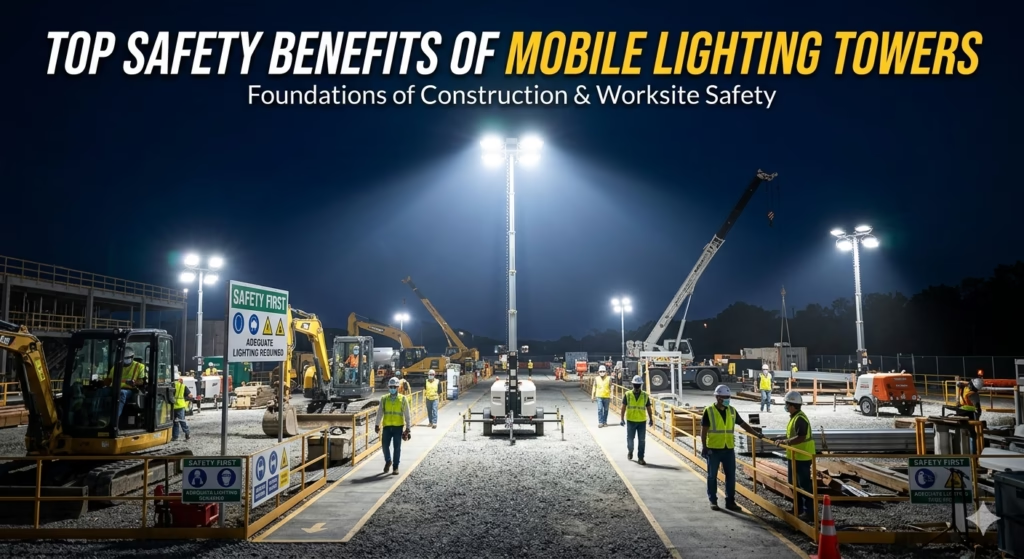
Introduction: Lighting Is a Safety Requirement, Not Just a Convenience
Every year, thousands of construction workers suffer preventable injuries while working at night or in low-light conditions. Studies consistently show that poor lighting increases the risk of slips, trips, falls, vehicle collisions, struck-by incidents, and equipment-related accidents.
Despite these risks, temporary lighting is often treated as an afterthought. Contractors typically prioritize machinery, materials, and labor before planning site illumination. This approach can lead to safety violations, higher accident rates, project delays, workers’ compensation claims, and, in severe cases, fatal injuries.
Mobile lighting towers provide a practical solution. Also known as portable lighting towers or temporary light towers, they deliver bright, wide-area illumination that keeps construction sites safe and productive after dark.
Today, these lighting systems are widely used across construction projects, roadworks, mining operations, emergency response zones, and large outdoor events.
This guide explores the top safety benefits of mobile lighting towers and explains how they help reduce risks, improve visibility, and support compliance with workplace safety regulations.
1. The Connection Between Lighting and Construction Safety
Before exploring the benefits of mobile lighting towers, it’s important to understand why lighting has such a significant impact on workplace safety.
How Poor Lighting Causes Accidents
Human vision depends on adequate light. When lighting levels drop, workers experience several visual limitations, including:
- Reduced visual clarity
- Poor depth perception
- Slower reaction times
- Difficulty identifying hazards
- Increased glare and contrast problems
These issues become especially dangerous on construction sites where workers operate heavy machinery, work at height, handle electrical systems, or move around uneven terrain.
Research published in occupational health journals shows that poorly lit worksites experience 30–50% more accidents than sites with adequate illumination.
Fatigue makes the problem even worse. Dim lighting reduces alertness and concentration, increasing the likelihood of mistakes and workplace injuries.
How Mobile Lighting Towers Improve Safety
Mobile lighting towers reduce these risks by providing bright, uniform illumination across large work areas.
Unlike permanent lighting systems, they can be:
- Deployed within minutes
- Easily relocated as the project progresses
- Used in remote locations without permanent infrastructure
- Removed once the project is complete
Most mobile lighting towers feature adjustable masts between 6 and 12 meters high. This elevated position distributes light evenly across the site while reducing shadows and dark spots.
Compared with handheld work lights, vehicle headlights, or temporary string lights, mobile lighting towers deliver much wider coverage and significantly better visibility.
2. How Mobile Lighting Towers Reduce Common Construction Hazards
The difference between a well-lit and poorly lit construction site is substantial. Proper illumination reduces many of the most common workplace hazards encountered during night operations.
| Hazard | Without Mobile Lighting Towers | With Mobile Lighting Towers |
|---|---|---|
| Slips, Trips & Falls | Very high risk | Reduced by up to 70% |
| Vehicle-to-Worker Collisions | High | Significantly reduced |
| Struck-by Incidents | High | Low |
| Electrical Hazards | Elevated | Minimal |
| Machinery Accidents | High | Reduced through better visibility |
| Emergency Response | Slower and more difficult | Faster and safer |
| Theft & Vandalism | High | Greatly reduced |
While lighting alone cannot eliminate every risk, it dramatically improves visibility, allowing workers to recognize hazards before they become accidents.
3. Eliminating Dark Zones: The Foundation of Site Safety
One of the biggest safety advantages of mobile lighting towers is their ability to eliminate dark zones.
Dark zones are areas where lighting is insufficient for workers to safely perform their tasks. These poorly lit spaces are responsible for many nighttime construction accidents.
Without proper lighting, construction sites often consist of isolated pools of light created by vehicle headlights or portable lamps. Workers moving between these areas are forced to navigate through darkness, making it difficult to spot hazards.
Common hazards hidden in dark zones include:
- Uneven ground
- Open trenches
- Construction debris
- Exposed reinforcing steel
- Electrical cables
- Moving machinery
- Stored materials
Even experienced workers can overlook these hazards when visibility is poor.
How Mobile Lighting Towers Eliminate Dark Zones
Modern LED mobile lighting towers provide broad, uniform illumination over large areas.
A single lighting tower can typically illuminate 4,000 to 5,000 square meters while maintaining more than 50 lux, which exceeds the minimum lighting level recommended for general construction site movement.
On larger projects, multiple towers can be arranged in a grid pattern. Their overlapping light coverage removes dark gaps and creates consistent illumination across the entire worksite.
This improves safety in several ways:
- Workers can clearly see where they are walking.
- Equipment operators can identify nearby personnel sooner.
- Supervisors gain better visibility across active work zones.
- Site inspections become faster and more accurate.
Instead of isolated patches of light, the entire worksite becomes a safe and visible working environment.
Industry Insight
According to the International Labour Organization (ILO), slips, trips, and falls account for more than 30% of serious construction injuries worldwide. Many nighttime incidents occur in areas with lighting levels below 20 lux, far below the recommended 50 lux minimum for general construction activities.
4. Preventing Vehicle and Heavy Equipment Accidents
Construction sites are busy environments where heavy machinery and workers operate in close proximity.
Excavators, dump trucks, cranes, forklifts, and concrete mixers constantly move around the site. Without adequate lighting, the risk of vehicle-to-worker collisions increases significantly.
These accidents remain one of the leading causes of fatalities in the construction industry.
Visibility Is the First Line of Defense
Safe interaction between workers and vehicles depends on one critical factor: visibility.
Both operators and pedestrians must be able to see each other early enough to react safely.
Poor lighting reduces that reaction time.
Vehicle operators may fail to notice workers entering their path, while workers struggle to judge the speed or direction of approaching equipment.
Mobile lighting towers solve this problem by illuminating the entire work area.
With adequate lighting:
- Operators can identify workers from a greater distance.
- Workers can easily spot moving equipment.
- Traffic controllers can safely direct vehicle movements.
- Drivers have more time to slow down or stop.
The result is fewer near misses and a lower risk of serious collisions.
Reducing Machinery Blind Spots
Heavy equipment operators rely on clear visibility to work safely.
Darkness hides important reference points such as:
- Grade stakes
- Underground utility markers
- Temporary barriers
- Nearby structures
- Other workers
Mobile lighting towers positioned around the work zone reduce these blind spots by illuminating equipment from multiple angles.
This improved visibility allows operators to make safer decisions during tasks such as:
- Crane lifts
- Excavation
- Concrete pouring
- Material handling
- Site grading
Many construction projects now require minimum lighting levels before night-shift operations involving heavy equipment can begin.
Conclusion
Mobile lighting towers are more than a temporary source of illumination—they are an important part of construction site safety. By providing bright, consistent, and wide-area lighting, they help reduce dark zones, improve worker visibility, support safer heavy-equipment operations, and make it easier to identify hazards before they cause accidents.
For projects that operate at night or in remote locations, choosing the right lighting system is essential. Factors such as light output, coverage area, mast height, mobility, power source, operating time, and site conditions should all be considered when selecting a mobile lighting tower.
Portaled provides reliable tower lighting solutions designed for construction sites, industrial facilities, mining operations, and other demanding outdoor applications. With the right tower lighting system, contractors can create safer working conditions while maintaining productivity during nighttime operations.
If your project requires dependable illumination for construction or industrial work, explore Portaled – Reliable Tower Lighting for Construction & Industry to find a lighting solution suited to your site requirements.
Leave a Reply