
Introduction
Across construction sites, mining operations, and nighttime industrial projects, area lighting is often viewed as a basic necessity rather than a strategic operational asset. However, tower lights that operate for 10–12 hours every night over several years can account for a significant portion of fuel consumption and maintenance expenses far more than many site managers realize.
The shift from conventional metal halide or high-intensity discharge (HID) lighting to LED tower lights is more than a technology upgrade. It is a measurable investment that can substantially reduce operating costs while improving reliability and sustainability.
This article explains why LED tower lights have become the technically superior choice for industrial area lighting by examining their energy efficiency, service life, maintenance requirements, total cost of ownership (TCO), and compliance with internationally recognized safety and environmental standards.
Energy Efficiency: The Foundation of Cost Savings
The most significant difference between LED and HID/metal halide lighting lies in luminous efficacy—the amount of light produced per watt of electrical power consumed.
Traditional metal halide lamps typically deliver 65–100 lumens per watt, while modern heavy-duty outdoor LED lighting systems commonly achieve 130–160 lumens per watt. Premium LED solutions from manufacturers such as Philips Lumileds and Cree LED often exceed these figures.
This means an LED tower light can produce the same illumination level while consuming substantially less power.
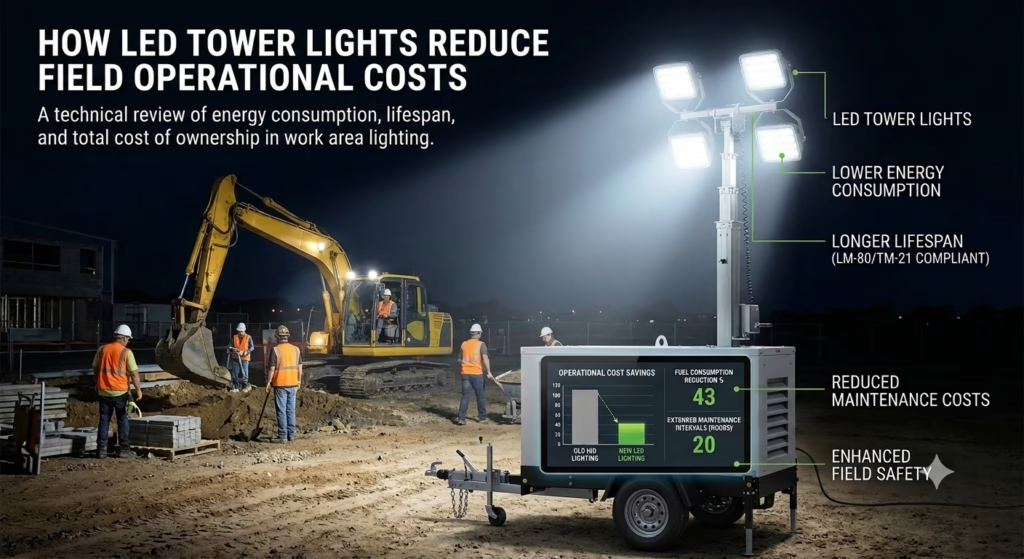
For diesel-powered tower lights, this translates directly into lower fuel consumption. Depending on equipment configuration and operating conditions, many projects experience 30–50% fuel savings after switching from HID to LED lighting.
On projects operating 10 hours each night for several months, these savings accumulate into thousands of liters of diesel fuel. The financial impact becomes even greater at remote mining and construction sites where fuel transportation significantly increases operating costs.
Longer Service Life and Lower Total Cost of Ownership
Energy consumption is only one component of operating costs. Component lifespan has an equally important impact on long-term expenses.
Conventional metal halide lamps generally provide an effective service life of 6,000–15,000 operating hours before lumen depreciation significantly reduces lighting performance.
In comparison, heavy-duty LED tower lights are commonly rated for 50,000–100,000 hours, provided they use effective thermal management systems. These performance ratings are typically based on the LM-80 and TM-21 testing methodologies used throughout the lighting industry to evaluate lumen maintenance over time.
The difference is substantial.
A single LED lighting system can remain operational through multiple project cycles without lamp replacement, while HID systems require regular bulb changes. Although replacing a lamp appears straightforward, it introduces additional costs including:
- Replacement parts
- Maintenance labor
- Equipment downtime
- Lost productivity during servicing
When evaluated using Total Cost of Ownership (TCO) rather than initial purchase price alone, the higher upfront investment of LED tower lights is often recovered through lower fuel consumption and reduced maintenance costs within 12–24 months of intensive operation.
Compliance with International Standards
For organizations that prioritize workplace safety and regulatory compliance, selecting equipment that meets internationally recognized standards is essential.
Ingress Protection (IP) ratings defined by IEC 60529 remain one of the most important specifications for outdoor lighting equipment. Tower lights rated IP65 or IP66 are generally suitable for dusty environments and heavy rainfall commonly encountered on industrial worksites.
For the lighting fixtures themselves, IEC 60598 specifies electrical and mechanical safety requirements for luminaires.
Resistance to dust, water, vibration, and mechanical shock is also commonly evaluated using testing methods comparable to ISO 20653, particularly for heavy equipment and automotive applications.
Projects operating in hazardous environments such as underground coal mines or gas processing facilities must also consider explosion protection certifications under ATEX (Europe) or IECEx, which define equipment requirements for explosive atmospheres.
Leading manufacturers including Atlas Copco, Doosan Portable Power, Wacker Neuson, Generac, and Trime typically specify compliance with these standards in their product documentation.
Rather than relying on marketing claims such as “weatherproof” or “all-weather operation,” procurement teams should verify compliance with recognized international standards before making purchasing decisions.
Operational Considerations in Indonesia
Indonesia presents unique operating conditions that further strengthen the case for LED tower lights.
Many construction, mining, and infrastructure projects outside Java operate without access to the national electricity grid, relying entirely on portable diesel generators for lighting.
Every watt saved by LED technology directly reduces generator load, leading to:
- Lower diesel fuel consumption
- Longer generator service intervals
- Reduced engine wear
- Lower maintenance costs
These benefits are particularly valuable where fuel logistics are expensive or challenging.
Another growing trend across Indonesia’s construction and mining industries is the adoption of hybrid solar-generator systems and battery-powered tower lights.
Because LEDs require significantly less power than HID lighting, these hybrid solutions become technically practical. Solar panels and reasonably sized battery banks can often provide overnight lighting without continuous generator operation, reducing fuel dependence in remote locations.
Measurable Environmental Benefits
Lower energy consumption also delivers measurable environmental advantages.
Every liter of diesel fuel saved by a generator reduces associated carbon dioxide (CO₂) emissions, making LED tower lights an effective solution for companies pursuing sustainability goals.
Traditional metal halide lamps also contain small amounts of mercury, requiring careful disposal as hazardous waste after replacement.
LED lighting contains no mercury, simplifying waste management procedures and supporting compliance with increasingly strict environmental regulations.
The technology also aligns with international initiatives such as RoHS (Restriction of Hazardous Substances), which encourages the reduction of hazardous materials in electrical and electronic equipment.
Considerations Before Switching to LED
Despite their many advantages, LED tower lights are not without trade-offs.
Initial purchase prices are typically 15–30% higher than comparable HID systems because of the cost of LED drivers, electronics, and thermal management components.
For very short-term rental projects lasting only a few weeks, the operational savings may not fully offset the higher acquisition cost.
In addition, LED performance depends heavily on proper thermal design.
Poorly engineered heat sinks can significantly shorten LED lifespan, preventing products from achieving their advertised operating hours.
For this reason, buyers should evaluate manufacturers based on proven engineering, transparent testing data, warranty support, and overall product reliability not simply advertised lumen output.
Conclusion
Switching to LED tower lights demonstrates how a seemingly simple equipment decision can produce significant operational benefits.
Lower fuel consumption, reduced maintenance requirements, longer service life, and improved environmental performance combine to deliver meaningful reductions in overall operating costs.
For contractors, mining companies, equipment rental firms, and industrial operators planning for long-term efficiency, evaluating tower lights based on Total Cost of Ownership (TCO) and compliance with international standards rather than purchase price alone is the smarter and more sustainable approach.
Technical Standards and References
- IEC 60529 — Ingress Protection (IP) ratings for electrical equipment
- IEC 60598 — Safety requirements for luminaires
- ISO 20653 — Protection testing against dust, water, and mechanical exposure for vehicle and heavy equipment applications
- ATEX / IECEx — Hazardous area equipment certification for explosive atmospheres
- LM-80 / TM-21 — LED lumen maintenance testing and lifetime projection methodologies
- RoHS — Restriction of Hazardous Substances framework for electronic equipment
Leave a Reply