
Introduction
In today’s competitive construction, mining, and event management industries, operational efficiency is everything. Among the most significant yet often overlooked expenses on any large-scale project is fuel consumption, particularly for lighting equipment. Traditional metal halide and halogen tower lights rely heavily on diesel generators to produce sufficient illumination, driving up costs and carbon emissions simultaneously.
Fortunately, the rapid advancement of LED (Light Emitting Diode) technology has opened the door to a smarter alternative. LED tower lights are now capable of delivering superior luminous output at a fraction of the energy demand, resulting in substantial fuel savings over the lifetime of a project. This article explores in depth how transitioning to LED tower lights can reduce fuel costs, improve operational efficiency, and contribute to a greener worksite all while maintaining the high standards of visibility and safety that modern projects demand.
1. Understanding the Fuel Cost Problem in Conventional Tower Lighting
Traditional lighting towers powered by diesel generators are workhorses on construction sites, roadworks, quarries, and outdoor events. However, they carry a steep price tag in the form of fuel. A standard metal halide tower light typically draws between 1,000 and 2,000 watts per lamp, and with four to six lamps per tower, the power demand quickly climbs to 8–12 kW per unit.
To meet this demand continuously throughout the night, diesel generators must operate at high load levels. Depending on the generator size and load factor, a single conventional tower light can consume anywhere from 4 to 8 liters of diesel per hour. For a project running 10-hour night shifts, that translates to 40–80 liters of diesel per tower, per night. Multiply this by multiple towers across several months, and the fuel bill becomes a major budget line item not to mention the logistics cost of fuel delivery and storage.
Beyond direct fuel costs, there are indirect consequences: generator maintenance, oil changes, filter replacements, and the environmental penalties associated with diesel emissions. All of these hidden costs accumulate and erode project margins significantly.
2. How LED Tower Lights Reduce Fuel Consumption
The fundamental advantage of LED technology lies in its superior energy efficiency. LEDs convert a much higher proportion of electrical energy into visible light compared to conventional sources. While a metal halide lamp may achieve 75–100 lumens per watt, modern high-output LEDs routinely deliver 130–180 lumens per watt nearly double the efficiency.
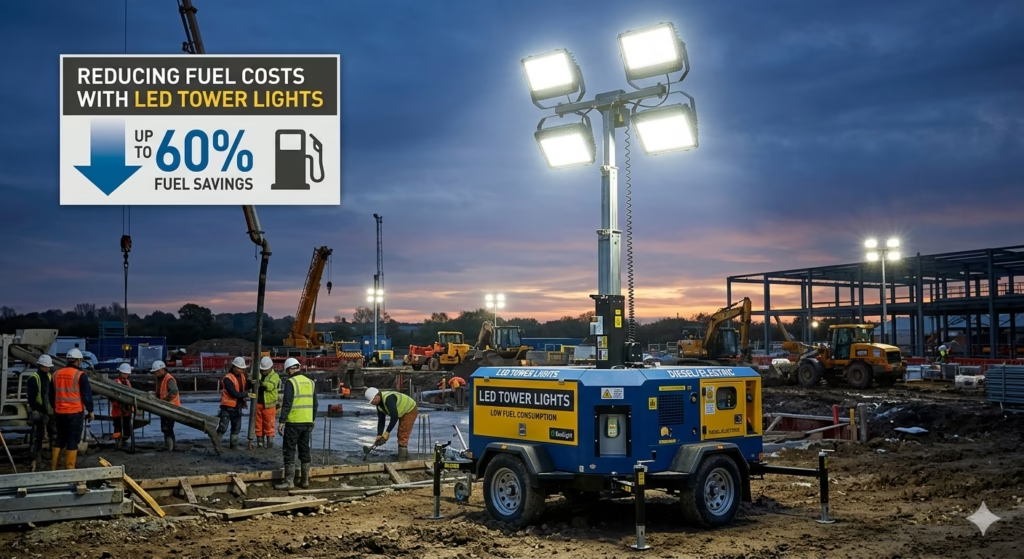
This dramatic improvement in efficacy means that an LED tower light can produce the same or greater illumination as its conventional counterpart while consuming significantly less power. A high-efficiency LED tower drawing just 400–600 watts can match or exceed the output of a 1,000-watt metal halide unit, reducing power demand by up to 60%.
Key Fuel Savings Metrics:
- Up to 60–70% reduction in generator load per tower
- Smaller generators can be used, further cutting fuel burn and rental costs
- LED towers on hybrid or battery-assisted systems can operate for 100+ hours without refueling
- Some solar-LED hybrid tower lights eliminate generator dependency entirely during optimal conditions
When generator load drops significantly, the engine operates more efficiently at a lower RPM and fuel consumption curve. Depending on the generator type and load management system, this efficiency gain can further reduce fuel burn by an additional 10–20% beyond the direct LED savings.
3. ROI: Calculating the Return on Investment
One of the primary concerns project managers face when considering LED tower lights is the upfront cost. LED units typically cost more than traditional halogen or metal halide alternatives. However, when viewed through a total cost of ownership (TCO) lens, LED tower lights almost universally deliver a compelling return on investment within the first few months of operation.
Sample Cost Comparison (Per Tower, Per Month):
Traditional Metal Halide Tower (10 hrs/night, 30 nights/month):
- Fuel consumption: ~60 liters/night × 30 = 1,800 liters/month
- Fuel cost at $1.20/liter = $2,160/month per tower
- Generator maintenance: ~$150/month
- Total: ~$2,310/month
LED Tower Light (same operating schedule):
- Fuel consumption: ~20 liters/night × 30 = 600 liters/month
- Fuel cost at $1.20/liter = $720/month per tower
- Generator maintenance (less frequent): ~$80/month
- Total: ~$800/month
The monthly saving per tower is approximately $1,510. For a fleet of 10 towers, that equates to over $15,000 in monthly savings enough to recover the cost of new LED equipment in just a few weeks on a large project.
4. Solar-Powered and Hybrid LED Tower Lights: The Zero-Fuel Option
The evolution of LED tower lighting does not stop at improved efficiency alone. Many manufacturers now offer solar-LED hybrid tower lights that integrate photovoltaic (PV) panels with high-capacity battery banks to dramatically reduce or even eliminate diesel generator dependency.
These systems work by charging batteries during daylight hours and discharging stored energy to power LED arrays during the night. On sunny days with moderate illumination requirements, some solar tower lights can operate indefinitely without any fuel input at all. In partially cloudy or winter conditions, a small backup generator may operate for a few hours at minimal load, reducing overall fuel consumption by 80–90% compared to conventional towers.
For remote sites where fuel delivery is logistically challenging and expensive, solar-LED hybrids offer a transformative advantage. Projects in mining, oil and gas, and infrastructure development in off-grid locations stand to gain the most from this technology both in terms of cost savings and operational simplicity.
- No daily refueling required in full-solar mode
- Reduced noise pollution ideal for urban or residential-adjacent worksites
- Lower carbon footprint a growing requirement for ESG-compliant contractors
- Minimal maintenance costs over the product lifecycle
5. Additional Operational Advantages of LED Tower Lights
Beyond fuel savings, LED tower lights offer a range of ancillary benefits that contribute to overall project efficiency and safety.
Longer Lifespan
LED arrays typically have a rated lifespan of 50,000 to 100,000 hours, compared to 6,000–15,000 hours for metal halide lamps. This means fewer lamp replacements, reduced downtime, and lower maintenance labor costs over the course of a project.
Instant On/Off Performance
Unlike metal halide lamps that require a warm-up period of 3–5 minutes before reaching full brightness, LEDs achieve full output instantly. This eliminates wasted energy during startup cycles and allows operators to switch lights on only when needed further reducing unnecessary fuel consumption.
Better Light Quality
LEDs produce a higher Color Rendering Index (CRI) and a more consistent, white light spectrum compared to the yellowish output of sodium vapor or the harsh glare of metal halide. Better light quality translates directly into improved worker visibility, reduced eye fatigue, and enhanced safety on the worksite.
Directional Lighting Control
LED tower systems often feature adjustable heads and beam angle control, allowing operators to direct light precisely where it is needed. This eliminates light spillage and wasted illumination, ensuring every watt of generated power is put to productive use.
Smart Energy Management
Many modern LED tower lights come equipped with smart control systems, including motion sensors, programmable timers, and remote monitoring capabilities. These features allow automatic dimming or shutdown during periods of low activity, contributing to further fuel savings without sacrificing safety.
6. Environmental Benefits and Regulatory Compliance
Reducing fuel consumption is not only a financial imperative but also an environmental one. Diesel generators are a significant source of CO2, NOx, and particulate matter emissions. By switching to LED tower lights and reducing generator runtime, construction companies can meaningfully lower their project-level carbon footprint.
This is increasingly important as governments and clients alike impose stricter environmental standards on contractors. In many jurisdictions, emission limits, noise ordinances, and green procurement policies are driving the adoption of energy-efficient equipment. Contractors who proactively invest in LED tower technology are better positioned to win tenders, comply with environmental regulations, and demonstrate corporate social responsibility (CSR) commitments.
- Reduced CO2 emissions per operational hour
- Compliance with Stage V emission standards when paired with modern generators
- Support for LEED and BREEAM sustainability certification requirements
- Lower noise pollution in communities adjacent to construction sites
7. Choosing the Right LED Tower Light for Your Application
Not all LED tower lights are created equal, and selecting the right unit for your specific application is critical to maximizing fuel savings and performance. Key selection criteria include:
- Lumen output: Match the light output to site requirements (typically 80,000–400,000 lumens for construction and industrial use)
- Tower height: Higher mast heights provide broader coverage per tower, reducing the number of units needed
- Power source compatibility: Consider whether the unit supports solar, battery, hybrid, or generator power
- IP rating: Ensure adequate ingress protection for the operating environment (IP65 or higher for outdoor use)
- Portability: Towable units offer flexibility for large or dynamic worksites
- Smart controls: Look for dimming, motion detection, and remote monitoring features to optimize energy use
8. Practical Tips for Maximizing Fuel Savings on Your Jobsite
Switching to LED tower lights is the single most impactful step, but further optimization is possible with the right operational practices.
- Conduct a lighting audit before deployment to determine the minimum number of towers needed for adequate coverage
- Use right-sizing strategies to match generator capacity precisely to the reduced load of LED equipment
- Implement shift-based lighting schedules so towers operate only during active work hours
- Enable motion-sensing or timer-based auto-dimming during low-activity periods
- Consolidate lighting power supply by running multiple LED towers from a single, appropriately sized generator
- Track fuel consumption data regularly to identify anomalies and further optimization opportunities
- Consider rental programs for LED tower lights if capital expenditure is a constraint the operating savings often cover rental costs within weeks
Conclusion: LED Tower Lights as a Strategic Investment
The case for switching from conventional to LED tower lights is compelling on every dimension financial, operational, and environmental. By reducing power demand by up to 60–70%, enabling the use of smaller generators, and opening the door to solar-hybrid zero-fuel operation, LED tower lights deliver transformative fuel cost savings that compound over the life of any project.
For project managers, fleet operators, and sustainability officers, the question is no longer whether to adopt LED tower lighting it is how quickly the transition can be made to begin capturing the benefits. The upfront investment is rapidly recovered through fuel savings alone, while the downstream gains in maintenance reduction, compliance, and worker safety provide long-lasting value well beyond the bottom line.
As energy costs continue to rise and environmental regulations tighten, LED tower lights are set to become not just a competitive advantage, but an operational necessity for any forward-thinking organization operating in the field.
Leave a Reply