
Introduction
Lighting is one of the most overlooked yet mission-critical elements of any construction project. Whether your team is working after sunset, operating in enclosed structures, or managing a 24-hour worksite, the right tower light can directly impact worker safety, productivity, and project timelines.
Yet many contractors and procurement managers still choose tower lights based purely on price without considering key factors such as lumen output, mast height, power source, portability, runtime, and compliance with local safety regulations. This leads to costly mismatches: underpowered lights that leave workers in the dark, oversized units that are impossible to reposition, or diesel-powered machines that violate urban noise restrictions.
This comprehensive guide walks you through everything you need to know about how to choose the right tower light for your construction project. From understanding lumen requirements and coverage area to selecting the ideal power source and evaluating total cost of ownership, this article provides the practical, expert-level knowledge that turns a complex purchasing decision into a clear, confident choice.
1. Understand What a Tower Light Actually Does
Before diving into selection criteria, it is important to understand what a construction tower light is designed to do. A tower light also known as a lighting tower or light tower is a portable, freestanding unit that elevates one or more high-intensity floodlights to a height that maximizes the spread of light across a large horizontal area.
Unlike fixed floodlights or string lights, tower lights are engineered for:
- Wide-area coverage — illuminating thousands of square meters from a single unit
- Portability — mounted on trailers or skids for repositioning across large job sites
- Self-sufficiency — integrated power sources that require no external electrical connection
- Durability — built to withstand the dust, vibration, and weather extremes of construction environments
A well-chosen tower light does more than simply illuminate a site. It enables night-shift operations, reduces safety incidents caused by poor visibility, accelerates project completion, and ensures compliance with occupational health and safety (OHS) regulations that mandate minimum lighting levels for hazardous work environments.
2. Assess Your Site’s Lighting Requirements
The first and most important step in selecting a tower light is accurately assessing the lighting needs of your specific construction site. Getting this wrong in either direction wastes money: too little light creates safety hazards, while excessive lighting is an unnecessary capital and operational expense.
Step 1: Calculate the Area to Be Illuminated
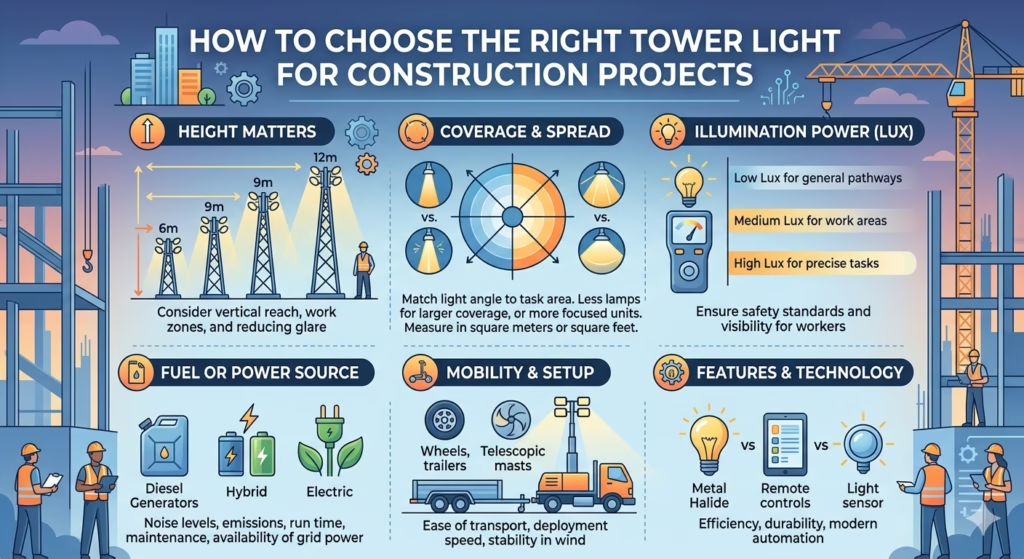
Measure the total area of your worksite that requires lighting during low-light or nighttime operations. A standard portable tower light with four 500W metal halide heads can illuminate approximately 4,000 to 5,000 square meters. Modern LED tower lights of equivalent electrical output can illuminate the same area while consuming 30 to 50 percent less energy.
For very large sites such as highway construction corridors, major earthworks, or open-cut mining multiple units should be strategically positioned to achieve uniform coverage without dark zones.
Step 2: Determine Required Illuminance Levels
Occupational safety standards in most countries specify minimum lux levels (lumens per square meter) for different types of construction activity. Common benchmarks include:
- General site movement and access routes: 20 to 50 lux
- Active construction work areas: 100 to 200 lux
- Precision tasks (formwork, electrical, finishing): 200 to 500 lux
- Emergency access and first aid areas: 50 to 100 lux minimum
Always verify the specific lux requirements set by your country’s workplace health and safety authority before specifying lighting equipment. Under-illuminated sites expose employers to significant legal and financial liability in the event of accidents.
3. Choose the Right Power Source
The power source is arguably the most consequential decision you will make when selecting a tower light. It determines operating costs, environmental impact, noise levels, fuel logistics, and runtime reliability. There are three primary options available:
Diesel-Powered Tower Lights
Diesel tower lights use an integrated combustion engine and generator to produce electricity for the floodlights. They are the traditional industry standard and remain the preferred choice for high-continuity, remote, or extreme-environment applications. Key advantages include unlimited runtime (with fuel supply), consistent performance in any weather, and wide availability of spare parts and service.
The primary disadvantages are high fuel costs (typically 1 to 2 liters per hour), significant CO2 and NOx emissions, engine noise (65 to 75 dB), and the logistical burden of maintaining a diesel supply chain on remote sites.
Solar-Powered Tower Lights
Solar tower lights use photovoltaic panels to charge a battery bank that powers LED floodlights. They are silent, emission-free, and have very low operating costs once deployed. They are ideal for long-duration projects in regions with reliable daily sunlight, urban sites with noise restrictions, and organizations with sustainability mandates.
The limitations of solar tower lights include dependency on daily solar harvest, reduced battery capacity in cold weather, and higher upfront capital cost compared to diesel equivalents. Premium models address these limitations with oversized battery banks and optional hybrid backup systems.
Hybrid Tower Lights
Hybrid units combine solar panels and battery storage with a diesel generator that activates only when battery charge drops below a preset threshold. This approach reduces diesel consumption by 60 to 80 percent compared to a pure diesel unit while maintaining the runtime reliability needed for 24/7 operations. Hybrid tower lights represent the fastest-growing segment of the construction lighting market and are increasingly specified on large-scale infrastructure projects.
4. Evaluate Mast Height and Light Head Configuration
Mast height directly determines the spread and uniformity of illumination across your site. A light mounted higher casts a wider, more even beam reducing harsh shadows and eliminating dangerous dark spots between pools of light.
Standard Mast Height Ranges
- 6 meters (20 feet): Suitable for small worksites, access routes, and enclosed areas
- 8 to 9 meters (26 to 30 feet): The industry standard for most open construction sites
- 12 meters (40 feet): Required for large earthworks, open-cut excavations, and events
- Custom telescoping masts: Available on premium units for flexible height adjustment
Light Head Types and Technology
The type of light head fitted to the tower significantly affects both performance and operating efficiency:
- Metal Halide (MH): The traditional standard, producing bright white light with high lumen output. Requires warm-up time (2 to 5 minutes) and is less energy-efficient than LED. Being phased out in favor of LED.
- LED (Light Emitting Diode): The modern benchmark. Instant full-brightness startup, 50,000+ hour lifespan, 40 to 60 percent lower energy consumption than metal halide, and better performance in cold climates. Strongly recommended for all new purchases.
- 360-Degree Rotating Heads: Allow light to be directed at specific areas of the site without moving the tower unit, significantly improving operational flexibility on complex worksites.
5. Consider Portability and Mobility Requirements
Construction sites are dynamic environments. The lighting solution that works perfectly in week one may need to be repositioned as the project progresses through different phases from site preparation and foundations to structural works and finishing. Portability is therefore a critical specification, not an afterthought.
Trailer-Mounted Units
The majority of construction tower lights are trailer-mounted for towing behind a pickup truck or utility vehicle. Key portability factors to evaluate include:
- Gross trailer weight (GTW): Heavier units require higher-rated tow vehicles
- Wheel configuration: Single-axle for lighter units; tandem-axle for heavy diesel models
- Outrigger stability legs: Essential for safe deployment on uneven terrain
- Folding mast and light head: Allows transport under low bridges and through site gates
Skid-Mounted Units
Skid-mounted tower lights are designed for deployment by forklift or crane in locations where a trailer is impractical — such as elevated floors of a building under construction, confined underground spaces, or platforms. They sacrifice some mobility for maximum stability in fixed locations.
Compact and Balloon Lights
For smaller sites or confined spaces, compact tower lights and balloon (inflatable diffuser) lights offer a lightweight, easily repositionable alternative. Balloon lights in particular eliminate harsh shadows and glare, making them popular for finishing works and public-facing nighttime construction in urban areas.
6. Review Weather Resistance and Environmental Ratings
Construction environments are inherently harsh. Dust, moisture, vibration, and extreme temperatures can quickly degrade poorly specified lighting equipment, leading to premature failure, costly downtime, and potential safety incidents. Always verify the environmental protection ratings of any tower light before deployment.
IP (Ingress Protection) Ratings
The IP rating system (defined by IEC standard 60529) classifies the degree to which electrical enclosures resist the ingress of solid particles and liquids. For construction tower lights, look for:
- IP54 minimum: Protection against dust ingress and water splashing from any direction suitable for most outdoor construction environments
- IP65 or higher: Fully dust-tight and protected against water jets recommended for tropical climates, high-rainfall regions, or sites with active water use (concrete washing, dewatering)
- IP66 / IP67: Required for flooding-prone sites, coastal locations, or units that may be partially submerged
Operating Temperature Range
Verify that the tower light’s engine, battery, and electrical components are rated for the temperature extremes of your project location. Lithium-ion batteries lose significant capacity below -10°C, while diesel engines may require block heaters in arctic conditions. Conversely, solar panel efficiency drops above 45°C in desert environments a factor that should be accounted for when sizing the solar array.
7. Calculate Total Cost of Ownership (TCO)
A common mistake in tower light procurement is evaluating purchase price in isolation. The true financial cost of a tower light over its operational life the Total Cost of Ownership (TCO) includes multiple components that must be modeled over your expected project duration or asset lifespan.
TCO Components to Evaluate
- Purchase price or rental rate
- Fuel costs (diesel units): liters per hour x operating hours x fuel price per liter
- Scheduled maintenance: oil changes, filter replacements, engine servicing
- Unscheduled repairs and parts replacement
- Operator time: refueling, maintenance checks, mast operation
- Transport costs: towing vehicle, mobilization/demobilization
- Battery replacement (solar units): typically every 5 to 7 years
- Regulatory compliance costs: emissions testing, noise monitoring
For projects lasting longer than 12 months in areas with adequate sunlight, solar tower lights consistently deliver lower TCO than diesel equivalents, despite higher upfront costs. For short-term rentals of 3 months or less, diesel units typically offer lower total cost due to their lower initial hire rate.
8. Pre-Purchase Checklist: 10 Questions to Ask Before You Buy
Use the checklist below to ensure you have covered every critical specification before committing to a tower light purchase or rental contract:
| Checklist Item A | Checklist Item B |
| ☐ Site area & lumen requirement calculated? | ☐ Power source decided (diesel / solar / hybrid)? |
| ☐ Mast height suitable for coverage? | ☐ Weather & IP rating checked for location? |
| ☐ Portability & trailer type assessed? | ☐ Budget (purchase vs rental) compared? |
| ☐ Safety & compliance standards verified? | ☐ Maintenance plan & spare parts available? |
| ☐ Runtime hours per night confirmed? | ☐ Noise restriction at site reviewed? |
9. Buy vs Rent: Making the Right Financial Decision
For many construction companies, the decision to purchase or rent tower lights is as important as the specification decision itself. Each approach has distinct financial and operational implications.
When Renting Makes More Sense
- Project duration is less than 6 months
- Lighting requirements change significantly between project phases
- Capital budget is constrained and must be directed to core plant and equipment
- The project is in a new geographic region where the contractor has no existing fleet
- Access to the latest technology without long-term ownership commitment
When Buying Makes More Sense
- Consistent lighting requirements across multiple long-term projects
- Rental market in the project region is limited or unreliable
- Total rental cost over projected use exceeds purchase price within 18 to 24 months
- The company has in-house maintenance capability to manage the fleet
- Tax depreciation benefits make asset purchase financially favorable
10. Safety, Compliance, and Regulatory Considerations
No tower light selection process is complete without a thorough review of the safety and compliance requirements applicable to your project location and industry. Regulatory non-compliance can result in work stoppages, substantial fines, and — most critically — preventable worker injuries.
Key compliance areas to verify before deploying tower lights on a construction site include:
- Minimum lux levels for specific work activities as defined by your national OHS authority
- Electrical equipment certification and compliance with local electrical standards
- Emissions standards particularly in urban areas or environmentally protected zones
- Noise ordinances many municipal authorities impose strict dB limits for nighttime operations
- Safe working loads and wind ratings for the mast at full extension
- Operator training requirements for mast erection and tower light deployment
Always request compliance documentation and test certificates from the supplier before accepting delivery of any tower light unit. Reputable manufacturers will provide full certification documentation as a matter of course.
Conclusion: The Right Light Changes Everything
Choosing the right tower light for your construction project is not simply a procurement task it is a strategic decision that affects worker safety, operational efficiency, project timelines, and your organization’s environmental and financial performance.
By systematically evaluating your site’s lumen and coverage requirements, selecting the appropriate power source, specifying the correct mast height and light head technology, assessing portability needs, verifying weather resistance ratings, calculating total cost of ownership, and confirming regulatory compliance, you can make a confident, well-informed selection that delivers maximum value throughout your project lifecycle.
The construction lighting market has never offered more capable, efficient, and environmentally responsible options than it does today. LED technology, advanced battery systems, hybrid power solutions, and smart IoT monitoring are transforming what tower lights can do. The investment you make in getting the specification right today will pay dividends in safety, productivity, and cost savings across every project you undertake.
Frequently Asked Questions
Q: How many tower lights do I need for my construction site?
A: As a general rule, one standard tower light covers approximately 4,000 to 5,000 square meters. Divide your total site area by this figure and add 20 percent to account for overlapping coverage zones and shadow elimination. Always consult a lighting engineer for large or complex sites.
Q: What is the best type of tower light for urban construction?
A: Solar-powered LED tower lights are the preferred choice for urban construction due to their silent operation, zero emissions, and compliance with municipal noise ordinances. Balloon lights are also popular in urban environments for their glare-free illumination.
Q: How long can a tower light run on a full tank of diesel?
A: Runtime depends on engine size and fuel tank capacity. A typical unit with a 70-liter tank running at 1.5 liters per hour will operate for approximately 45 to 47 hours before refueling roughly 4 to 5 nights of 10-hour operation.
Q: Are LED tower lights worth the higher upfront cost?
A: Yes, in almost all cases. LED floodlights consume 40 to 60 percent less energy than equivalent metal halide units, last up to 10 times longer (50,000+ hours vs 5,000 hours), and require virtually no lamp replacement maintenance. The energy savings alone typically recover the price premium within 12 to 18 months of operation.
Q: What IP rating do I need for a construction tower light?
A: IP54 is the minimum recommended for general outdoor construction. Specify IP65 or higher for sites with heavy rainfall, active water use, or coastal locations. Always check the IP rating of both the light heads and the generator/battery enclosure, as these may differ.
Leave a Reply