
Introduction
Temporary lighting remains a common challenge on construction sites, event venues, emergency response areas, and remote worksites. These locations need reliable illumination for a limited time, yet installing permanent electrical infrastructure rarely makes financial sense.
For decades, diesel-powered lighting towers have been the standard solution. Contractors tow them to the site, refuel them regularly, and remove them when the project ends. Today, portable solar lighting towers offer a practical alternative for many of these applications. Their advantages extend well beyond eliminating diesel fuel.
This article explores five practical benefits of portable solar lighting towers based on real-world performance. It also explains their key limitations so you can determine whether a solar tower suits your project.
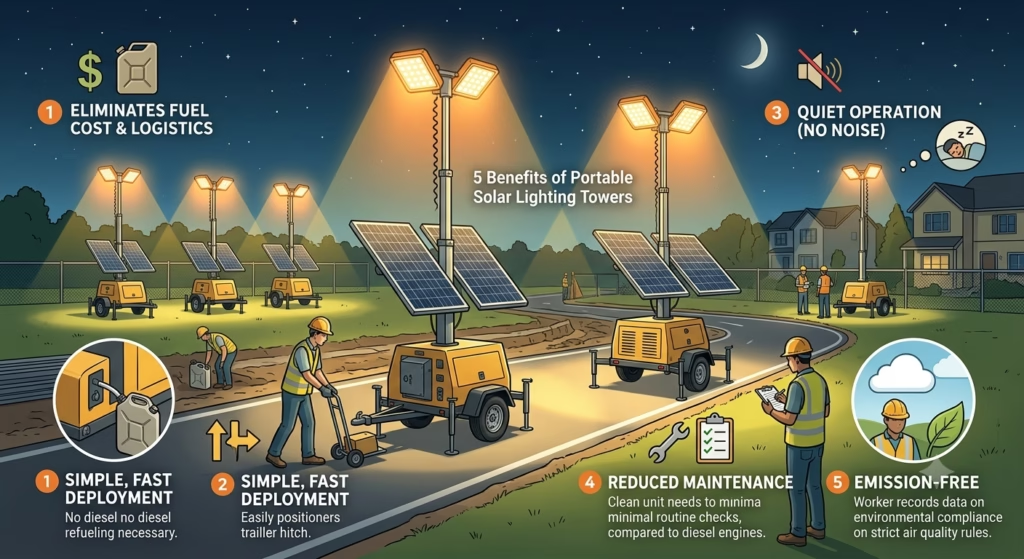
1. Eliminates Fuel Logistics and Ongoing Fuel Costs
Every diesel lighting tower consumes fuel throughout every operating shift. Site managers must schedule fuel deliveries for the entire project, especially when multiple towers operate across different work zones. Any delay in refueling can leave part of the site without lighting, reducing both safety and productivity.
Portable solar lighting towers remove this dependency. Once workers position the tower in an area with sufficient sunlight, the solar panels recharge the battery during the day. The stored energy then powers the lights throughout the night.
This approach eliminates fuel deliveries, fuel storage, and concerns about delayed refueling. Over several months, even a small fleet of solar towers can reduce operating costs significantly. Actual savings depend on local diesel prices and the number of towers in service.
2. Fast Deployment and Easy Relocation
Manufacturers build most portable solar lighting towers on trailer chassis similar to diesel models. Crews can tow them with a standard vehicle and deploy them without trenching cables or connecting to an external power supply.
Because the unit has no engine, fuel tank, or exhaust system, setup is straightforward. Workers simply extend the mast, position the solar panels toward the sun, and switch on the lights.
This flexibility becomes especially valuable when lighting requirements move with the project. Road construction, pipeline installation, and temporary event venues often require frequent relocation. Crews can move a solar tower in minutes, allowing work to continue with minimal downtime and less logistical coordination.
3. Reduces Noise on Site
Even a well-maintained diesel lighting tower produces continuous engine noise while operating. That noise becomes a major concern near residential neighborhoods, hospitals, schools, or other noise-sensitive areas, particularly during nighttime work.
Portable solar lighting towers operate without a combustion engine. As a result, they produce virtually no generator noise.
This advantage extends beyond worker comfort. Many projects must comply with local noise regulations or environmental permit conditions. A quiet lighting system can help contractors continue nighttime operations instead of limiting work to daytime hours, protecting both productivity and project schedules.
4. Reduces Maintenance Requirements
Diesel lighting towers require routine engine maintenance. Operators must change the oil, replace fuel filters, and perform scheduled servicing to maintain reliable performance. These tasks become more difficult when equipment is spread across large or remote worksites.
Fuel management creates additional responsibilities. Site personnel must monitor storage, prevent spills, and reduce the risk of fuel theft.
Portable solar lighting towers simplify maintenance by eliminating the engine. Instead, technicians primarily inspect the battery system, electrical connections, and solar panels.
Modern lithium iron phosphate (LiFePO₄) batteries offer long cycle life and require far less maintenance than traditional lead-acid batteries. Solar towers still require periodic inspections and occasional panel cleaning, and every battery eventually reaches the end of its service life. Even so, routine maintenance remains lighter than that of an equivalent diesel-powered unit.
5. Supports Emission Reduction and Environmental Compliance
Portable solar lighting towers generate no exhaust emissions during normal operation. This gives them a clear environmental advantage over diesel-powered units that must comply with emission standards such as EPA Tier 4 or EU Stage V.
Many contractors now work under sustainability targets, environmental permits, or ESG reporting requirements. Using zero-emission lighting equipment helps companies document lower emissions across temporary site operations. In many projects, these records contribute directly to environmental reporting and regulatory compliance.
Where Portable Solar Towers Have Real Limitations
Portable solar lighting towers do not replace diesel lighting in every application.
Battery capacity remains limited. A tower operating at maximum brightness during several cloudy days or throughout seasons with limited daylight may not recharge enough to maintain full overnight performance. Increasing battery and solar panel capacity can solve this problem, but it also increases equipment cost.
Projects in regions with heavy monsoon conditions or sites requiring extremely high illumination levels often exceed the practical capability of a solar-only system.
Purchase price is another consideration. Solar towers typically cost more upfront because high-capacity batteries and solar panels account for a significant portion of the system cost.
Whether that investment pays off depends on operating hours and fuel prices. A tower used every night on a long-term project usually recovers its additional cost much faster than one that remains idle for most of the year.
Matching the Tower to the Application
Many contractors achieve the best results by combining multiple lighting technologies.
They often deploy portable solar lighting towers for perimeter security, parking areas, or moderate-traffic work zones with good sun exposure. Diesel or solar-hybrid towers remain the preferred choice for demanding applications where maximum brightness and uninterrupted operation are critical.
Solar-hybrid towers provide a practical compromise. They combine batteries with a smaller diesel engine that starts only when battery charge becomes low. This design reduces fuel consumption significantly while maintaining dependable operation during poor weather or extended nighttime use.
Ultimately, the right choice depends on the project itself. Consider available sunlight, required light output, project duration, and local noise or emission regulations before selecting a lighting solution. Portable solar lighting towers perform exceptionally well in many temporary lighting applications, but they should complement not automatically replace every diesel lighting tower.
Conclusion
Portable solar lighting towers provide several measurable advantages over diesel-powered units. They eliminate fuel logistics, simplify deployment, reduce maintenance, operate quietly, and produce zero exhaust emissions during use.
These benefits are greatest in locations with reliable sunlight and moderate lighting demands. Projects requiring extremely high output or operating through prolonged periods of poor weather may achieve better results with hybrid or diesel-powered systems.
The best lighting solution always depends on the application. Evaluating each project individually allows contractors to maximize fuel savings, improve operational efficiency, and reduce environmental impact without sacrificing reliability.
Leave a Reply