
A Practical Guide to Safe, Efficient, and Cost-Effective Mining Illumination
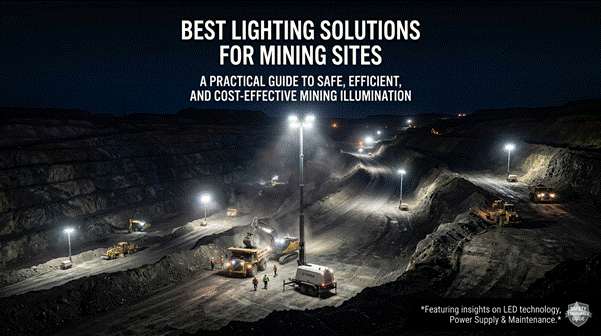
Lighting on a mining site is not a secondary consideration it is a core safety and productivity infrastructure. Whether you are running an open-pit coal operation, an underground gold mine, or a quarrying site, the quality and reliability of your lighting directly determines how safely and efficiently your team can work, especially during night shifts or in naturally dark environments.
Yet lighting is one of the most mismanaged aspects of mining infrastructure. Many operations still rely on outdated technology, undersize their systems for the actual work area, or neglect the critical relationship between reliable power supply and lighting performance. The result: preventable accidents, reduced productivity, and far higher long-term costs than necessary.
This guide walks through everything you need to know about selecting, deploying, and maintaining the best lighting solutions for mining sites from the technology options available today to the power systems that keep them running reliably.
Why Mining Site Lighting Is a Life-Safety Issue
The statistics on mining accidents tied to poor visibility are sobering. According to occupational health data across major mining regions, a significant portion of equipment-related injuries and fatalities occur during reduced-visibility conditions night shifts, underground corridors, or dust-heavy environments where lighting was insufficient, poorly positioned, or simply failed.
Mining environments create unique lighting challenges that standard industrial lighting cannot reliably address, including:
- Extreme dust and particulate contamination that coats lamp surfaces and reduces light output over time
- Vibration from heavy machinery and blasting that shortens the life of non-ruggedized fixtures
- Water ingress in both surface operations (rain, drainage) and underground workings
- Explosive atmospheres in underground mines where methane, coal dust, or other flammable materials are present
- Vast areas requiring high, uniform lumen output often across terrain that is constantly changing as excavation progresses
- Remote locations where power infrastructure is either unavailable or unreliable
A lighting solution that performs adequately in a factory or warehouse will fail quickly and dangerously in a mining environment. This is why mining lighting requires purpose-built, rated equipment and why getting it right matters far more than saving a few dollars on cheaper fixtures.
Types of Lighting Solutions for Mining Applications
1. LED Tower Lights (Light Towers)
For surface mining operations open pits, quarries, and processing yards LED light towers are the gold standard. A modern LED light tower on a telescoping mast can deliver 100,000 to 360,000 lumens of output, effectively illuminating an area equivalent to several football fields from a single unit.
The shift from metal halide to LED light towers has been transformative for mining operations. LED towers offer:
- Instant-on capability eliminates warm-up time, providing immediate illumination when shifts begin or after a power interruption.
- 50,000–100,000+ hour lamp life, compared to 6,000–15,000 hours for metal halide equivalents
- 60–70% lower energy consumption for equivalent lumen output
- Significantly reduced heat output, lowering the risk of combustion near flammable materials
- Better colour rendering index (CRI 70+) which improves operator ability to distinguish hazards, ground conditions, and equipment
Modern LED tower lights are also available with remote monitoring capabilities, allowing site managers to check light status, power consumption, and fault alerts without physical inspection a major operational advantage on large or remote sites.
2. Explosion-Proof LED Fixtures (ATEX / IECEx Certified)
Underground mining environments present a categorically different challenge: the risk of igniting flammable gases or dust. In these zones, only explosion-proof (Ex-rated) lighting equipment is legally and safely permissible.
Explosion-proof LED fixtures use specially engineered enclosures to contain any internal ignition, preventing sparks, arcs, or excessive heat from escaping into the surrounding atmosphere even if an internal fault occurs. Key specifications to understand:
- Match the fixture’s certification to your hazardous area classification: Zone 0, 1, or 2 for gas atmospheres, and Zone 20, 21, or 22 for combustible dust atmospheres.
- IP68 rating as a minimum for permanently wet or submerged underground environments
- T-class rating (temperature class): must be lower than the auto-ignition temperature of the gases present
- Verify that the fixture carries ATEX or IECEx certification to ensure compliance with internationally recognized hazardous-area standards.
| ⚠ Safety Compliance Notice Using non-explosion-proof lighting in a designated hazardous zone is not only a regulatory violation it can cause a fatal explosion. Never substitute standard industrial LED fixtures in underground zones without verifying the exact hazardous area classification and matching it to your fixture’s certification documentation. |
3. LED Floodlights for Machinery and Work Zones
Fixed LED floodlights serve a different purpose: targeted, high-intensity illumination of specific work areas such as processing plants, loading zones, crusher stations, conveyor systems, and vehicle maintenance bays. Install these fixtures on poles, gantries, or building structures at heights of 8–20 metres.
For mining-grade floodlights, look for a minimum IP65 rating, IK10 impact resistance (for areas exposed to mechanical impact or blasting vibration), and a wide-beam optic that minimizes shadows in critical work areas. Anti-glare options are increasingly important as mines face regulations on light pollution and driver safety on haul roads.
4. Solar-Powered LED Lighting Systems
For remote surface areas perimeter fencing, access roads, stockpile monitoring zones, or satellite work areas far from the main power grid solar-powered LED systems have become a viable and increasingly cost-effective option.
A well-designed solar lighting system integrates high-efficiency monocrystalline panels, lithium or AGM battery banks with 3–5 days of autonomy (to handle cloudy periods), and LED fixtures with intelligent controllers that adjust output based on ambient light and battery state of charge.
The key advantage is eliminating the cost and complexity of cable runs across large mining tenements. The key limitation is output capacity: solar systems cannot currently match the lumen output of mains-powered or generator-powered tower lights for primary work area illumination. Deploy these fixtures as secondary or supplementary lighting in lower-intensity areas.
Mining Lighting Comparison at a Glance
The table below compares the major lighting technologies across the metrics that matter most to mining operations:
| Lighting Type | Lumen Output | Power Draw | IP Rating | Best Use Case |
| LED Tower Lights | 100,000–360,000 lm | 1,000–3,600 W | IP65–IP68 | Open pit, large areas |
| LED Floodlights | 10,000–80,000 lm | 100–800 W | IP65–IP67 | Machinery, entry points |
| Explosion-Proof LED | 5,000–50,000 lm | 50–500 W | IP66–IP68 | Underground, gas zones |
| Solar + Battery LED | 10,000–50,000 lm | 0 W (grid) | IP65 | Remote perimeter areas |
| HID/Metal Halide | 20,000–100,000 lm | 250–1,000 W | IP54–IP65 | Legacy, being phased out |
Note: Lumen and wattage ranges are indicative for mining-grade fixtures. Actual specifications vary by manufacturer and model. Always verify ratings against your site’s specific requirements before procurement.
Key Standards and Certifications to Know
Purchasing mining lighting without understanding the relevant standards is a risk that no responsible site manager should take. The following certifications and ratings are not optional marketing features they are minimum requirements for safe deployment:
Ingress Protection (IP) Ratings
The IP rating system (IEC 60529) defines protection against solid particles and liquids. For mining environments, never specify below IP65 for any outdoor fixture. Underground fixtures in wet conditions require IP67 or IP68. The difference between IP65 (water jets) and IP68 (continuous immersion) is critical in underground sump areas or drainage-exposed corridors.
IK Impact Resistance Rating
IK10 is the highest impact resistance rating, indicating protection against 20 joules of impact energy roughly equivalent to a 5 kg weight dropped from 40 cm. Use IK10-rated fixtures for any low-to-medium mounting height installation in mining environments, where equipment and materials frequently impact nearby surfaces.
ATEX / IECEx for Hazardous Areas
As mentioned above, any lighting used in classified hazardous zones must carry the appropriate ATEX or IECEx certification. These certifications require independent laboratory testing and ongoing audits they are not self-declared. When purchasing explosion-proof equipment, always request the original certificate documentation and verify the serial number matches.
Lux Level Standards
Different areas of a mining site have different minimum lux requirements under occupational health regulations. As a general reference:
- Haul roads and travel ways: 10–20 lux minimum
- Active work zones and loading areas: 50–100 lux minimum
- Processing plants and maintenance bays: 200–500 lux minimum
- Control rooms and high-precision work areas: 500+ lux
A proper lighting design study using photometric simulation software should be conducted before specifying fixtures, to ensure compliance and avoid costly redesigns after installation.
The Role of Power Supply in Mining Lighting Reliability
Here is a reality that too many mining operations learn the hard way: the best LED lighting system in the world is completely useless the moment power fails. And in mining particularly on remote sites, during commissioning phases, or in regions with unreliable grid infrastructure power failure is not an ‘if’ but a ‘when’.
This is why your lighting solution cannot be evaluated in isolation from your power supply infrastructure.
Generator-Powered Lighting Systems
For sites without grid access, or as backup power for critical lighting circuits, diesel generators remain the most reliable and widely deployed power source. A well-maintained generator set provides consistent voltage and frequency output that LED lighting systems require for stable, flicker-free operation.
When specifying a generator for lighting loads, account for:
- Total connected lighting wattage plus a 20–25% headroom buffer
- Inrush current from LED drivers at startup though significantly lower than metal halide, large banks of LEDs can still cause momentary demand spikes
- Runtime requirements: a light tower used for a 12-hour night shift requires a generator with sufficient fuel capacity and a service interval that does not interrupt operations
- Load bank testing before deployment generators should be tested at realistic loads before being relied upon for safety-critical lighting
| Choosing the Right Generator for Mining Lighting For mining lighting applications, industrial-grade diesel generators with AVR (Automatic Voltage Regulation) are strongly preferred over standard portable generators. AVR ensures stable voltage output even as lighting loads switch on and off throughout the shift preventing premature failure of LED drivers, which are sensitive to voltage fluctuations. Inverter-type generators are another option for smaller, sensitive LED systems, but their output capacity is typically insufficient for heavy mining lighting demands. |
Maintaining Your Power Equipment
The reliability of your lighting system is directly tied to the maintenance discipline applied to the generator and power distribution equipment supporting it. Key maintenance practices for mining site power systems include:
- Regular oil and filter changes on diesel generators at intervals appropriate to the operating hours, not calendar time
- Fuel quality management water contamination in diesel fuel is one of the most common causes of generator failure on mining sites, particularly in tropical climates
- Load testing under realistic conditions every 6–12 months, not just at idle
- Inspection of cable connections and distribution boards for corrosion, particularly in coastal or high-humidity environments
- Maintaining a spare parts inventory on site injectors, filters, belts, coolant hoses, and fuses should never need to be air-freighted during an emergency
When it comes to spare parts, the temptation to source the cheapest available option is understandable given the cost pressures on mining operations. However, substandard components particularly fuel filters, injector sets, and gaskets can cause generator failure at the worst possible time. Using original or OEM-equivalent parts from a trusted supplier is a non-negotiable operational standard.
If you are looking to source quality generator spare parts or need to upgrade your site’s power generation capacity, working with a supplier who understands the demands of mining and industrial operations not just standard residential or commercial gensets will save you significantly in both downtime and total repair costs. A good supplier will also help you identify the correct specifications for your existing equipment rather than selling you incompatible components.
Lighting Design Principles for Mining Sites
Good lighting on a mining site does not happen by accident. It requires deliberate design understanding the geometry of the work area, the tasks being performed, the equipment in use, and the way those factors change as the mine develops.
Uniformity Over Peak Brightness
A common mistake is optimising for maximum lux at a single point while neglecting uniformity across the work area. High-contrast lighting with very bright spots adjacent to dark zones is actually more dangerous than moderately lower overall illumination delivered uniformly. The human eye takes time to adapt between bright and dark areas, and in a dynamic mining environment with moving equipment, that adaptation lag can be fatal.
Aim for a uniformity ratio (minimum lux / average lux) of at least 0.4 across active work zones, and 0.25 across transit areas.
Lighting for Haul Road Safety
Haul road lighting deserves special attention. Fatigue-related incidents on haul roads are a major cause of serious accidents in large-scale open pit operations. Well-designed haul road lighting positioned to illuminate the road surface, shoulders, and any fixed obstacles without creating glare for approaching operators has been demonstrated to reduce fatigue incidents during night operations.
Avoid mounting lights directly in the line of sight of approaching drivers. Use asymmetric optics that direct light downward and forward rather than toward oncoming traffic.
Planning for Site Expansion
Mining sites are dynamic the active face moves, processing areas expand, and infrastructure is relocated. Your lighting design should anticipate this by favouring modular, relocatable systems (tower lights on wheeled trailers, for instance) rather than fixed pole infrastructure in areas likely to be disturbed within 12–24 months.
Selecting the Right Equipment and Supplier
The mining equipment market is unfortunately not short of substandard products marketed with impressive-sounding specifications. Here is a practical checklist for evaluating lighting and power equipment for your mining site:
- Request IES photometric files from the manufacturer these allow your lighting designer to run accurate simulations rather than relying on marketing claims
- Verify IP and ATEX certifications against the original issuing laboratory’s database, not just the product label
- Ask for operational references from other mining clients using the same model in comparable conditions
- Evaluate the supplier’s spare parts availability a fixture that cannot be repaired within a reasonable lead time is a liability, not an asset
- Assess total cost of ownership, not just purchase price factor in energy consumption, lamp replacement cycles, and maintenance labour
| Why Your Supplier Matters as Much as Your Equipment The best lighting and generator equipment delivers its full value only when supported by a supplier who can provide genuine spare parts, technical expertise, and responsive after-sales service. On a remote mining site, a failed generator or light tower that cannot be repaired for two weeks because parts are unavailable is a safety incident waiting to happen. Choose suppliers who stock what you need and understand your operating environment not just the catalogue. |
Whether you need to replace a failed lighting tower, upgrade your site’s generator capacity, or build out a new lighting system for an expanding operation, sourcing from a specialist supplier with experience in mining and industrial applications will consistently deliver better outcomes than purchasing from a general electrical or hardware wholesaler. The right supplier will help you avoid specification mismatches, ensure regulatory compliance, and keep the critical spares on the shelf before you need them.
Maintaining Mining Lighting Systems for Long-Term Performance
Even the best-specified equipment requires consistent maintenance to perform reliably. Construction site conditions accelerate dust accumulation on optical surfaces, loosen electrical connectors through vibration, degrade gaskets from prolonged UV exposure, and repeatedly stress LED driver components through thermal cycling.
A practical maintenance schedule for mining lighting should include:
- Monthly: Visual inspection of all fixtures for physical damage, water ingress indicators, and visible lumen degradation. Clean optical surfaces with appropriate non-abrasive cleaning agents.
- Quarterly: Torque check of all mounting hardware and cable connections. Inspect gaskets and seals on explosion-proof fixtures replace any showing cracking, compression set, or chemical degradation.
- Bi-annually: Lux level measurements across key work zones to confirm ongoing compliance with minimum standards. Compare against original commissioning measurements to identify fixtures that require driver or LED module replacement.
- Annually: Full photometric audit of the site lighting layout. As the site geometry changes, previously compliant zones may develop dark spots or glare issues that require repositioning or adding fixtures.
Maintaining a site maintenance log recording inspection findings, replacement dates, and lux measurements is both a regulatory requirement in most jurisdictions and an invaluable tool for planning procurement and budget allocation.
Conclusion
Mining site lighting is not a commodity purchase it is a safety-critical infrastructure investment that affects every person on your site and every tonne of material you move. The technology landscape has never been better: modern LED solutions deliver dramatically superior performance compared to the metal halide and fluorescent systems they replace, and the economics are compelling even before accounting for the safety benefits.
But technology alone does not create a safe, well-lit mining site. It requires deliberate design, correct specification, rigorous compliance with standards, reliable power infrastructure, and consistent maintenance discipline. Shortcutting any of these elements will erode the value of even the best equipment.
Invest in the right equipment, maintain it properly, power it reliably, and source your parts and replacements from suppliers who genuinely understand the mining environment. That combination more than any single product specification is what keeps your people safe and your operation running through every shift, every season, and every phase of your mine’s life.
This article intended as general industry guide. Always consult a qualified lighting engineer and comply with all applicable local regulations and standards for your specific site and jurisdiction.
Leave a Reply