
Introduction
Remote worksites—including mining pits, oil and gas camps, plantation processing facilities, and telecom tower installations—share one critical requirement: reliable lighting. Night shifts, security patrols, and safe access around heavy equipment all depend on adequate illumination.
Most remote sites still rely on diesel generators to power lighting throughout the night. However, rising fuel costs and increasing environmental expectations are pushing operators to look for better alternatives. Lighting often becomes the first target because it operates on predictable schedules and is easier to upgrade than an entire site power system.
This article explains what eco-friendly lighting really means for remote worksites. It examines LED efficiency, solar and hybrid lighting towers, smart controls, equipment durability, and the situations where solar lighting is—and is not—the best choice.
Why Lighting Efficiency Matters at Remote Sites
In a grid-connected facility, inefficient lighting usually results in a higher electricity bill. At a remote site, the consequences are much greater.
Every inefficient fixture increases fuel consumption, extends generator operating hours, and requires more maintenance visits. Replacing a failed lamp may involve sending a technician several hours—or even an entire day—to reach the site.
Many remote worksites also leave lights running all night because crews cannot easily adjust operating schedules. This unnecessary runtime increases fuel consumption and operating costs.
Environmental compliance adds another challenge. Mining and oil and gas companies increasingly track fuel use and emissions across every part of their operations, including auxiliary systems such as lighting. Regulators, investors, and ESG reporting requirements continue to raise expectations for documenting environmental performance.
LED Technology: The Foundation of Efficient Lighting
LED fixtures remain the foundation of any eco-friendly lighting upgrade.
Compared with metal halide and high-pressure sodium lamps, LEDs convert much more electrical energy into usable light instead of heat. They also operate for tens of thousands of hours, while traditional lamps often require replacement after only a few thousand hours.
At remote sites, the biggest advantage is often reduced maintenance rather than lower electricity consumption. Longer service life means fewer technician visits, lower transportation costs, and less equipment downtime.
LED fixtures also reach full brightness instantly and handle frequent switching without reducing service life. This makes them ideal for motion sensors, scheduled dimming, and automated lighting controls.
Solar and Solar-Hybrid Lighting Towers
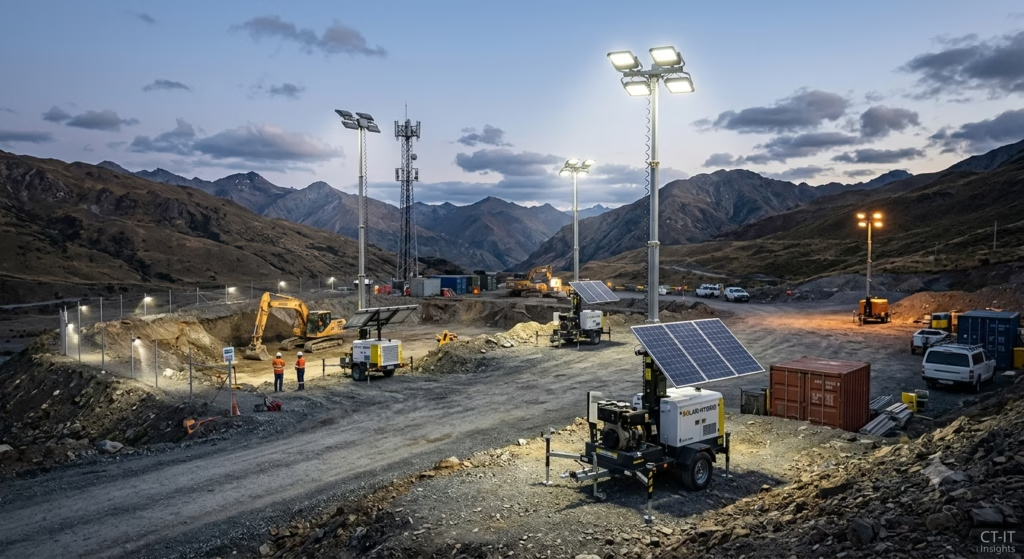
Standalone solar lighting towers combine photovoltaic panels, battery storage, and LED fixtures into a self-contained system. They work especially well for perimeter security, access roads, boundary fencing, and other low-traffic areas with good sun exposure.
Because these units generate and store their own energy, they eliminate fuel deliveries and generator dependence for each lighting location.
Higher-demand work zones require a different approach. Active construction areas, loading points, and heavy equipment operations often need continuous high-output lighting regardless of weather conditions.
In these applications, solar-hybrid lighting towers offer a more practical solution. They combine batteries with a backup diesel or petrol engine that starts only when battery charge becomes low. This design significantly reduces fuel consumption compared with running a diesel generator throughout the night.
Match Lighting Levels to Each Work Zone
Every part of a worksite has different lighting requirements. Applying the same light level everywhere wastes energy.
Task areas around machinery, loading stations, and active work zones usually require higher illumination to maintain safe operations. Perimeter roads, storage yards, and security fences often perform well with lower light levels.
Motion-activated lighting can improve efficiency even further. Fixtures remain dim during periods of inactivity and automatically increase brightness when workers or vehicles approach.
Dividing a site into lighting zones is one of the simplest ways to reduce energy consumption without compromising safety.
Smart Controls Reduce Operating Hours
Automatic lighting controls eliminate unnecessary runtime and improve overall energy efficiency.
Photocells automatically switch lights on at sunset and off at sunrise, removing the need for manual operation. Motion sensors reduce light output in low-traffic areas and restore full brightness only when activity occurs.
Programmable timers can also match lighting schedules to actual work shifts instead of keeping fixtures on throughout the night.
When lighting shares a generator with other equipment, these controls reduce the generator’s electrical load. Lower demand may even allow operators to use a smaller genset or improve the efficiency of an existing one during night operations.
Consider Generator Emissions
Many remote sites still rely on diesel generators to power part or all of their lighting system.
When selecting a backup generator, choose engines that comply with emissions standards such as EPA Tier 4 or EU Stage V whenever possible. Combining cleaner generators with LED fixtures reduces both fuel consumption and exhaust emissions.
Improving sustainability requires attention to both the power source and the lighting equipment itself.
Choose Equipment Built for Harsh Environments
Remote lighting systems must withstand conditions that urban installations rarely encounter.
Dust, humidity, vibration, heavy rainfall, and coastal salt air all reduce equipment life if fixtures are not properly protected.
An IP65 or IP66 enclosure rating provides a strong baseline for outdoor installations under IEC 60529. Corrosion-resistant housings and mounting hardware are equally important. Even the best LED fixture cannot perform reliably if its enclosure fails under harsh environmental conditions.
Plan Maintenance Before Problems Occur
Although LEDs last much longer than conventional lamps, every lighting system eventually requires maintenance.
Modular LED fixtures simplify repairs because technicians can replace drivers or LED modules instead of changing the entire fixture. This reduces repair costs and minimizes downtime.
Remote sites also benefit from keeping essential spare parts on hand. Stocking replacement drivers, photocells, and mounting hardware allows maintenance teams to restore service immediately instead of waiting several days for replacement parts to arrive.
Choosing Between Solar, Hybrid, and Diesel Lighting
Solar-only lighting towers are not the best solution for every project.
Sites with extended monsoon seasons, persistent cloud cover, or limited daylight may not generate enough solar energy to support reliable overnight operation. Increasing battery capacity and solar panel size can solve this issue, but doing so raises equipment costs.
Solar-hybrid towers often provide a better balance between efficiency and reliability under these conditions. They minimize fuel consumption while maintaining dependable performance during poor weather.
Many operators achieve the best results with a mixed fleet. They deploy solar-only towers in lower-demand areas, solar-hybrid units in critical work zones, and efficient LED fixtures with smart controls throughout the site.
Treating eco-friendly lighting as a complete site strategy—not simply a product purchase—delivers greater cost savings and stronger environmental performance.
Conclusion
Eco-friendly lighting at remote worksites depends on more than choosing a single lighting technology. It requires matching light output, power sources, and control systems to the needs of each work zone.
LED fixtures provide the foundation for energy efficiency. Solar and hybrid lighting towers reduce fuel consumption where site conditions allow, while smart controls eliminate unnecessary operating hours. Durable equipment also minimizes maintenance in locations that are difficult to access.
Sites that integrate lighting into their overall power strategy consistently achieve lower fuel costs, reduced emissions, and more reliable long-term performance.
Leave a Reply